
Anthropic Opus 4.8 Review 2026: The Latest Claude Reasoning Model
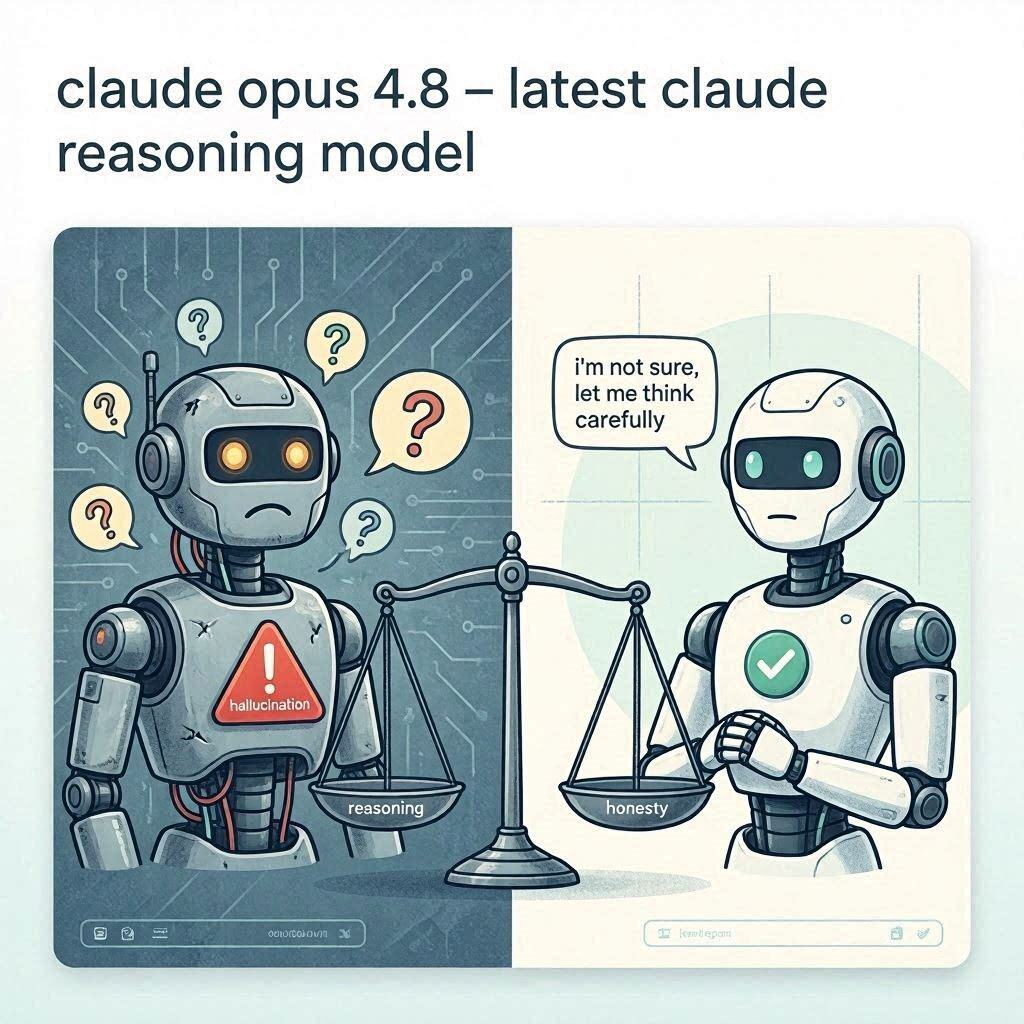
Anthropic Opus 4.8 Review 2026: The Latest Claude Reasoning Model Introduction In the world of AI language models, there are flashy ones and there are reliable ones. Chat GPT is flashy. Gemini is flashy. But when professionals need accurate, thoughtful, and safe responses – they turn to Claude.Anthropic Opus 4.8 is the latest flagship model from Anthropic. It’s not a massive leap forward – the company calls it a “modest improvement” – but in critical areas like coding, uncertainty handling, and complex reasoning, it makes a real difference.In 2026, Claude Opus 4.8 has become the preferred tool for developers, researchers, and professionals who need reliable, well-reasoned answers – not just fast, flashy ones.What is Anthropic Opus 4.8?Claude Opus 4.8 is the latest iteration of Anthropic’s most powerful AI model. It sits above Claude Sonnet (mid-tier) and Claude Haiku (fast, cheap) in Anthropic’s model family.Key characteristics:Feature Opus 4.8 Sonnet Haiku Intelligence Highest Medium Basic Speed Medium Fast Fastest Cost Highest Medium Lowest Best For Complex tasks Daily use Simple tasks What’s new in 4.8:Better coding results More likely to say “I’m not sure” (less hallucination)Improved handling of uncertainty Dynamic workflows with hundreds of sub agents Better long-context performance Key Features of Claude Opus 4.81. Improved Coding Capabilities Opus 4.8 shows significant improvement in coding tasks:Coding Task Opus 4.7 Opus 4.8Code generation Good Very Good Bug detection Good Very Good Code explanation Very Good Excellent Refactoring Good Very Good Documentation Very Good Excellent What this means: If you’re a developer, Opus 4.8 will write better code, find more bugs, and explain complex code more clearly.Real example:”Write a Python function to sort a list of dictionaries by multiple keys”Opus 4.8 generates clean, efficient code with error handling Explains each step of the sorting logic Provides example usage and edge cases 2. Better Uncertainty Handling This is one of the most important improvements. Opus 4.8 is more likely to say “I don’t know” instead of making things up.Scenario Opus 4.7 Opus 4.8Unknown topic May hallucinate Says “I’m not sure”Ambiguous question Guesses Asks for clarification Out-of-date info Gives old info Says “My knowledge may be outdated”Complex calculation May make errors Shows working, admits uncertainty Why this matters: Hallucination (AI making up fake information) is a major problem. Opus 4.8 hallucinates less.Real example:Question: “Who won the 2027 World Cup?”Opus 4.8: “I don’t have information about events that haven’t happened yet. My knowledge cutoff is [date]. I can help you find out once it happens.”3. Dynamic Workflows with Sub agents Opus 4.8 can break down complex tasks into hundreds of sub agents working in parallel:Task How Opus 4.8 Handles It Research project Spins up sub agents for each research question Code debugging Multiple sub agents analyze different parts Document analysis Parallel processing of sections Complex planning Sub agents handle different scenarios Example workflow:User asks: “Plan a marketing campaign for a new product”Opus 4.8 spawns sub agents for: market research, competitor analysis, budget planning, channel selection, content creation, timeline building Sub. agents work in parallel Results are synthesized into a complete plan 4. Long Context (200K tokens)Opus 4.8 maintains the 200,000 token context window – about the length of a 500-page novel.What you can do:Upload an entire book, ask questions about any part Analyze huge financial reports Review entire code bases Summarize long legal documents Have conversations that span hundreds of pages Real example: Upload the entire “Great Gatsby” (50,000 tokens). Ask: “What does the green light symbolize in Chapter 1 and Chapter 9?” Opus 4.8 finds both instances and explains the symbolism.5. Stronger Reasoning Opus 4.8 excels at multi-step reasoning:Reasoning Type Opus 4.8 Performance. Logical deduction Excellent Mathematical reasoning Very Good Scientific reasoning Very Good Legal reasoning Good Ethical reasoning Excellent Real example:Question: “If all A are B, and some B are C, can we conclude that some A are C?”Opus 4.8: Shows step-by-step logic, concludes “No, we cannot conclude that some A are C because the premises don’t guarantee overlap.”6. Constitutional AI (Safety)Anthropic’s signature Constitutional AI makes Opus 4.8 one of the safest models:Safety Feature How It Works Harmful content rejection Refuses illegal or dangerous requests Bias reduction Trained to be neutral and fair Transparency Explains why it refuses certain requests Honesty Says “I don’t know” when uncertain How to Use Claude Opus 4.8Method AccessClaude.ai (Web) Subscribe to Claude Pro ($20/month)Claude API Pay-per-token pricing Mobile app iOS and Android Slack integration Add Claude to your work space VS Code extension Code assistance in your editor Step by step:Step Action 1 Go to claude.ai2 Sign up (free tier available with Sonnet)3 Upgrade to Pro ($20/month) for Opus access 4 Select “Opus 4.8” from model selector 5 Type your prompt or upload files 6 Get high-quality, well-reasoned response Pricing Plan Cost Model Access Free $0 Claude Haiku (limited)Pro $20/month Opus + Sonnet + Haiku Team $25/user/month Opus + Sonnet + Haiku + team features Enter prise Custom All models + enterprise security API Pricing:Model Input Output Opus 4.8 $15 per million tokens $75 per million tokens Sonnet $3 per million tokens $15 per million tokens Haiku $0.25 per million tokens $1.25 per million tokens Claude Opus 4.8 vs Competitors Feature Claude Opus 4.8 Chat GPT-5 Gemini 2.0 Pro Deep Seek V3 Reasoning Excellent Very Good Very Good Good Coding Very Good Excellent Very Good Excellent Long Context 200K tokens 128K tokens 2M tokens 1M tokens Uncertainty Handling Excellent Good Good Good Safety Excellent (Constitutional AI) Good Good Basic Price $20/mo $20/mo $20/mo Free Best For Complex reasoning, safety General use, coding Long documents Free, coding. Verdict: Opus 4.8 is best for reasoning, safety, and uncertainty handling. For coding, Chat GPT-5 is competitive. For long context, Gemini wins. For free, Deep Seek V3 wins.Real-World Examples. Example 1: Complex Legal Analysis User: “Analyze this contract and identify potential risks.”Opus 4.8 Response:Reads the 50-page contract Identifies 8 potential risk areas Explains each risk in plain English Suggests specific language changes Prioritizes risks by severity Why Opus 4.8: Its careful reading and systematic analysis make it ideal for legal and compliance work.Example 2: Multi-Step Research User: “Help me understand the impact of AI on the job market in developing countries.”Opus 4.8 Response:Breaks down into sub-questions Ac. knowledges uncertainty where data is limited Cites known research Distinguishes between facts and expert opinions Concludes with balanced, thoughtful analysis Why Opus 4.8: Its willingness to say “I’m not sure” and careful handling of nuance make it trustworthy.Example 3: Ethical Dilemma User: “Is it ethical to use AI to screen job applications?”Opus 4.8 Response:Lists pros and cons Explains potential biases Discusses transparency requirements Offers no definitive answer (ethics are complex)Provides framework for decision-making Why Opus 4.8: Constitutional AI training makes it thoughtful about ethical questions.Pros and Cons✅ Pros Excellent reasoning – One of the best for complex tasks Honest uncertainty – Says “I don’t know” more often Less hallucination – More reliable answers Safe and ethical – Constitutional AI training Great for professionals – Lawyers, researchers, analysts Long context (200K tokens)Dynamic subagent workflows Transparent – Explains its reasoning❌ Cons Expensive ($20/month for Pro, higher API costs)Not the best at coding (Chat GPT-5 is better)Not the longest context (Gemini has 2M)Not free (Deep Seek V3 is free)Slower than Sonnet or Haiku Modest improvement (not revolutionary)Who Should Use Claude Opus 4.8?User Type Why Use Opus 4.8?Researchers Careful, nuanced analysis Lawyers Contract analysis, legal research Analysts Complex data interpretation Students Essay help, research assistance Writers Editorial feedback, brainstorming Developers Complex code reasoning (not coding)Anyone who needs reliable answers Less hallucination, better uncertainty When NOT to Use Opus 4.8Use Case Better Option Why Simple questions Claude Haiku Cheaper, faster Daily tasks Claude Sonnet Good enough, cheaper Coding Chat GPT-5 Better code generation Free Deep Seek V3 Completely free Very long documents Gemini 2.0 Pro 2M token context Frequently Asked Questions Is Claude Opus 4.8 free?No. Free tier gives you Claude Haiku (basic). Opus requires Pro subscription ($20/month).Is Opus 4.8 better than Chat GPT-5?For reasoning and safety, yes. For coding, Chat GPT-5 is better. Choose based on your needs.How is Opus 4.8 different from Sonnet?Opus is smarter, slower, and more expensive. Sonnet is the everyday workhorse.Does Opus 4.8 hallucinate less?Yes. Anthropic focused on reducing hallucinations and improving uncertainty handling.Can I use Opus 4.8 for coding?Yes, but Chat. GPT-5 is generally better for code generation.What’s the context length?200,000 tokens (about 500 pages).Final Verdict Claude Opus 4.8 is not the flashiest AI model. It doesn’t have the best coding or the longest context or the lowest price. But it has something more important: reliability.When you need a well-reasoned, honest, safe answer – especially for complex professional work – Opus 4.8 is one of the best tools available.The “modest improvement” in coding and uncertainty handling makes a real difference for professionals who can’t afford hallucinations.Is it worth $20/month? If you’re a researcher, lawyer, analyst, or student doing complex work – yes. If you just want to chat, use the free tier.Rating: 4.7/5 Best for: Researchers, legal professionals, analysts, students, anyone needing reliable reasoning Worst for: Budget users, pure coding tasks, simple everyday questions.